If you are planning to redesign a business website in India in 2026, you may find quotes ranging from a few thousand rupees to several lakhs.
So how much should you actually budget?
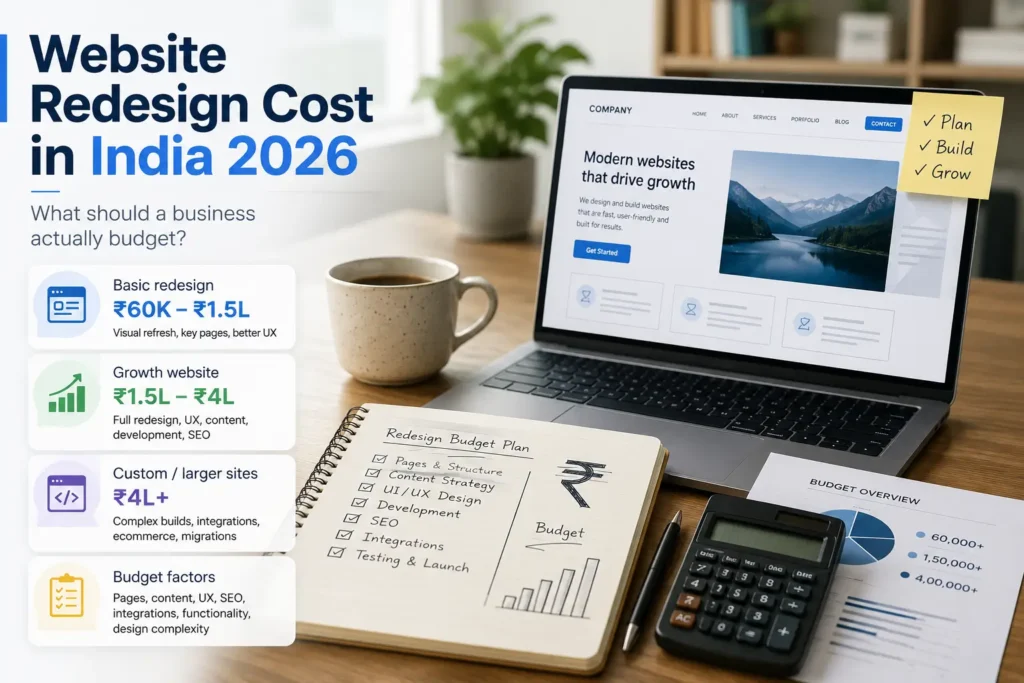
For planning purposes, a basic professional redesign may start around ₹60,000 and go up to ₹1.5 lakh. A more complete business website redesign involving UX, content, development, SEO and conversion work can fall in the ₹1.5 lakh to ₹4 lakh range. Larger websites, complex migrations, ecommerce and custom functionality can cost ₹4 lakh or more.
These are indicative budget ranges. There is no standard website redesign rate in India.
Before deciding how much to spend, there is a more important question:
What is actually wrong with your current website?
A business may need a complete redesign. It may also discover that only a few service pages, the enquiry process or its search visibility need attention.
Finding the real problem first can save a considerable amount of time and money.
Website redesign cost in India: a practical 2026 guide
The cost of redesigning a website depends largely on the scope of work.
A five-page service website is very different from a website with 100 pages, existing search traffic, multiple forms, integrations and years of published content.
For budgeting, it is useful to think about three broad types of projects.
| Type of redesign | Indicative budget | Typical scope |
|---|---|---|
| Basic redesign | ₹60,000 to ₹1.5 lakh | Visual refresh, key pages, mobile improvements, better UX and clearer calls to action |
| Growth website redesign | ₹1.5 lakh to ₹4 lakh | Structure, UX, content, development, SEO, conversion paths, analytics and lead capture |
| Custom or larger website | ₹4 lakh+ | Complex builds, migrations, ecommerce, custom integrations, large content volumes or advanced functionality |
These are planning bands, not fixed market prices.
Current public pricing published by Indian web agencies also varies widely. The difference usually comes down to what is included in the project.
First decide what kind of redesign you need
A common starting point is:
“Our website looks old. We need a new one.”
That may be true, but appearance is only one part of the problem.
A website redesign can mean several different things.
1. A visual refresh
Your current website may already have the right pages, useful content and a working CMS.
It may simply feel dated.
A visual refresh can include:
- Better typography
- Improved colours and spacing
- Cleaner mobile layouts
- Better use of images
- More consistent buttons and components
- Stronger calls to action
- Improvements to the homepage and important service pages
This is usually the simplest type of redesign.
If the website is technically sound and already receives useful search traffic, there may be no need to rebuild it from scratch.
2. A UX and conversion redesign
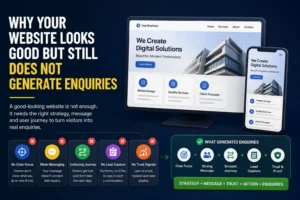
A website can look good and still struggle to generate enquiries.
Visitors may reach the site but find it difficult to understand:
- What the business offers
- Which service is right for them
- Why they should trust the company
- What action they should take
- How they should contact the business
In this situation, changing fonts and colours will not solve the main problem.
The buyer journey needs attention.
The work may include:
- Restructuring pages
- Simplifying navigation
- Improving service pages
- Adding stronger proof
- Making calls to action clearer
- Simplifying forms
- Improving the mobile experience
We have covered this problem in Why Your Website Looks Good But Still Does Not Generate Enquiries.
3. A content and positioning redesign
Businesses change over time.
Services evolve. Target customers change. New competitors enter the market. A company may now offer something quite different from what its website was originally built to explain.
In such cases, the design may not be the main issue.
The content and positioning may need to change.
This can include:
- A clearer value proposition
- Better service positioning
- New or improved service pages
- Stronger proof and case studies
- Better buyer-focused content
- Improved internal linking
- Search-led articles and guides
- A clearer homepage structure
A good service page should help a potential customer understand the offer and make a decision. It should not exist only to target keywords.
We explain this in What Makes a Service Page SEO-Friendly and Useful for Buyers?.
4. A complete rebuild
A full rebuild may make sense when the current website has deeper technical or structural problems.
Examples include:
- A difficult or outdated CMS
- Persistent performance problems
- Broken mobile layouts
- Templates that are difficult to update
- Security or maintenance problems
- Major new integrations
- Ecommerce requirements
- A major change in site structure
- Migration to or from WordPress
- A large number of pages that need to be migrated
At this point, the project involves more than visual design.
It becomes a content, technical and SEO migration as well.
What affects the cost of a website redesign?
The number of pages matters, but it is not the only factor.
Two ten-page websites can require very different amounts of work.
The following areas usually have the biggest impact on cost.
Strategy and discovery
Some redesign projects begin immediately with design.
Others first examine the business, the buyer and the current website.
Useful questions include:
- Who is the target customer?
- What are they looking for?
- What must they understand before they enquire?
- What creates trust?
- Where do visitors get confused?
- Which pages already work well?
- Which parts of the customer journey are weak?
The answers help determine whether a complete redesign is actually needed.
This is why a website audit or digital growth diagnosis can be useful before committing to a large project.
Content
Content can make a major difference to both the cost and the outcome.
There is a big difference between:
“Use our existing content in the new design.”
and:
“Help us restructure our services, improve our positioning and rewrite the important pages.”
The second requires more work because the project is also solving a communication problem.
Page templates
Do not look only at the number of pages.
Ask how many different page types have to be designed and developed.
A business website may include:
- Homepage
- Service pages
- About page
- Contact page
- Blog archive
- Article template
- Landing pages
- Case studies
- Location pages
- Product pages
A 50-page website that uses five consistent templates can sometimes be easier to build than a 15-page website where almost every page is different.
Development requirements
The cost can increase when the redesign includes technical work such as:
- Custom WordPress development
- Custom Gutenberg blocks
- Page builder cleanup
- CMS migration
- Third-party integrations
- Ecommerce
- Membership features
- Payment systems
- Booking systems
- CRM integration
- Advanced forms
- Custom dashboards
Every additional system has to be developed, connected and tested.
SEO migration
SEO should be considered before a redesign goes live.
If your existing website already receives organic traffic, changing URLs or removing content without a plan can affect search visibility.
Before launch, identify:
- Pages that currently receive search traffic
- URLs that should remain unchanged
- URLs that need to change
- Pages that are being removed
- Pages that are being combined
- Redirects that need to be created
- Important titles and metadata
- Internal links that need updating
- The XML sitemap for the new structure
Google recommends creating a clear mapping between old and new URLs when URLs change and using redirects to send users and search engines to the correct new location. (Google Search Central)
If a website already has useful search visibility, preserving it should be part of the redesign plan.
Lead capture and CRM
A redesign can also improve what happens after a visitor shows interest.
This may include:
- Contact forms
- WhatsApp enquiry routes
- Lead-source tracking
- CRM integration
- Lead qualification
- Email notifications
- Lead ownership
- Follow-up workflows
At this point, the project is not only improving the website.
It is also improving the path from website visitor to enquiry and from enquiry to sales follow-up.
We have explained why lead capture should be built before spending heavily on ads.
What should a website redesign quote include?
When comparing website redesign proposals, check what each quotation actually includes.
A lower quotation may simply cover less work.
| Area | What to check |
| Discovery | Will the current website and business requirements be reviewed first? |
| Site structure | Will navigation and page hierarchy be reconsidered? |
| UX | Will user journeys and conversion paths be improved? |
| Design | Is the design custom or mainly based on an existing template? |
| Content | Who will write, edit and migrate the content? |
| Development | Which CMS and development approach will be used? |
| Mobile | Will mobile layouts be tested properly? |
| SEO | Are redirects, metadata and migration checks included? |
| Analytics | Will analytics and tracking be checked? |
| Lead capture | Are forms, WhatsApp and CRM connections included? |
| Performance | Will website performance be tested? |
| QA | Which devices and browsers will be checked? |
| Training | Will your team know how to update the website? |
| Support | Is post-launch support included? |
Two companies can both quote for a “website redesign” while offering very different scopes.
That is why the final number alone does not tell you whether one proposal is better value.
When should you not redesign your website?
A complete redesign is not always the right answer.
If the website is not producing enough business, first identify where the problem actually sits.
You may have a traffic problem
If very few potential customers are reaching the website, redesigning it may have limited impact.
The immediate need may be SEO, content or distribution.
You may have an offer problem
Visitors may reach the website but still not understand why they should choose the business.
A new design will not fix an unclear offer by itself.
You may have a service-page problem
The homepage may work reasonably well while the service pages are weak.
In that situation, improving a small number of important pages may be a better investment than rebuilding the whole website.
You may have a lead-capture problem
Visitors may already be interested, but the enquiry process may be poor.
Common problems include:
- Forms that ask for too much information
- Weak calls to action
- Unclear WhatsApp routes
- No lead-source tracking
- Poor confirmation after enquiry
Fixing these problems may improve results without a full redesign.
You may have a follow-up problem
A website can generate leads and still appear to perform badly if those leads are not handled properly.
For example:
- Nobody owns the lead
- Responses are slow
- Enquiries are not qualified
- Follow-ups are inconsistent
- Lead sources are not tracked
- There is no simple CRM process
A website redesign cannot solve all of these problems.
This is why we use the Digital Growth System to identify where the customer journey is actually breaking.
How should a business plan its website redesign budget?
A simple five-step process can help.
Step 1: Define the problem
Avoid starting with:
“We need a modern website.”
Instead, describe what is not working.
For example:
“People are reaching our service pages, but they do not understand the difference between our services and very few submit an enquiry.”
That gives the redesign team something specific to investigate.
Step 2: Identify what already works
Make a list of assets worth keeping.
This may include:
- Important URLs
- Existing search rankings
- Useful content
- Analytics
- Forms
- Integrations
- Strong landing pages
- Technical functionality
A redesign should not discard useful assets simply because they are old.
Step 3: Separate essentials from extras
Website budgets can expand quickly.
Animations, custom illustrations and advanced interactions may be useful, but they should come after the basics.
Start with:
- Clear positioning
- Easy navigation
- Mobile usability
- Trust
- Search visibility
- Conversion
- Lead capture
- Measurement
Then decide what additional design features are worth paying for.
Step 4: Compare scope, not just price
If one company quotes ₹75,000 and another quotes ₹2 lakh, ask what each proposal includes.
The lower quotation may be exactly what you need.
It may also exclude areas such as content, SEO migration, analytics, CRM integration or post-launch support.
Compare deliverables and responsibilities before comparing prices.
Step 5: Measure what happens after launch
A redesign is not successful simply because the website looks better.
After launch, monitor:
- Organic search traffic
- Important landing pages
- Enquiry volume
- Enquiry quality
- Form completion
- Mobile usage
- Website performance
- Sales feedback
A good business website should continue to improve after launch.
Can a website redesign affect SEO?
Yes.
A redesign can affect search performance when URLs, content, internal links or technical signals are changed carelessly.
If URLs need to change, create a clear mapping between the old URLs and the correct new pages.
Avoid redirecting every removed page to the homepage.
After launch, check:
- Google Search Console
- Indexing
- XML sitemap
- Important URLs
- Redirects
- 404 errors
- Canonicals
- Organic landing pages
- Mobile rendering
Google recommends using redirects when URLs move so that users and search engines reach the correct new destination. (Google Search Central)
Freelancer or agency: which is better for a redesign?
There is no single answer.
A freelancer may be a good choice when:
- The scope is clearly defined
- The site is relatively simple
- Content is already prepared
- The current platform can be retained
- One person can handle most of the work
A broader team may be more useful when the project needs several capabilities, such as:
- Business positioning
- Content
- UX
- UI
- Development
- SEO
- Analytics
- CRM integration
- Lead capture
- Project management
The important question is whether the person or team has the skills required for your project.
Frequently asked questions
How much does a website redesign cost in India in 2026?
For planning purposes, a basic professional redesign may cost around ₹60,000 to ₹1.5 lakh.
A more complete business website redesign involving UX, content, development, SEO and conversion work may fall around ₹1.5 lakh to ₹4 lakh.
Complex websites, major migrations, ecommerce and custom functionality can cost ₹4 lakh or more.
Actual pricing depends on scope, complexity and what is included in the project.
Can I redesign a website for ₹25,000?
It may be possible for a small website with a very limited scope.
For example, the existing platform, content and structure may all remain unchanged while only selected visual elements are improved.
At that budget, check carefully whether strategy, content rewriting, SEO migration, custom UX, integrations and testing are included.
Should I change all my URLs during a redesign?
Usually not.
If an existing URL is useful and already performs well, there may be no reason to change it.
When URLs do need to change, redirect the old URLs to the most relevant new pages.
Do I need a complete redesign if my website is not generating leads?
Not necessarily.
First check whether the main problem is traffic, positioning, content, trust, conversion, lead capture or follow-up.
A complete redesign makes sense when the website itself is a major part of the problem.
Is WordPress suitable for a business website redesign?
For many service businesses, publishers and content-led companies, WordPress can be a practical choice.
It provides control over pages and content and supports SEO, analytics, forms, CRM connections and many other integrations.
The right platform still depends on what the website needs to do.
Before you approve a website redesign
Do not begin only with:
“How much will a new website cost?”
Ask:
“What is not working in our current digital journey?”
If the website is the problem, redesign it.
If a few important pages are weak, improve those pages.
If potential buyers cannot find the business, work on search visibility.
If enquiries are coming in but getting lost, improve lead capture and follow-up.
The purpose of a website redesign is to solve a real business problem.
At Design Wiz Tech, we look at the wider journey across the website, search visibility, content, conversion and lead follow-up before recommending the next step.
If you are not sure whether you need a full redesign, start with a Digital Growth Diagnosis and identify the most useful first intervention.