Many businesses start with ads because ads feel like the fastest way to grow.
The thinking is simple. If more people see the business, more people will enquire. If more people click, more leads will come. If more traffic reaches the website, sales should improve.
Sometimes that happens. But often, the result is disappointing.
The business spends money. Traffic increases. A few people click. Some visitors browse the website. Then most of them leave without doing anything useful.
The problem is not always the ad campaign.
The problem is often what happens after the click.
If your website, landing page, form, WhatsApp path or follow-up process is weak, paid traffic will only expose the weakness faster. Ads can bring attention, but attention is not the same as a lead.
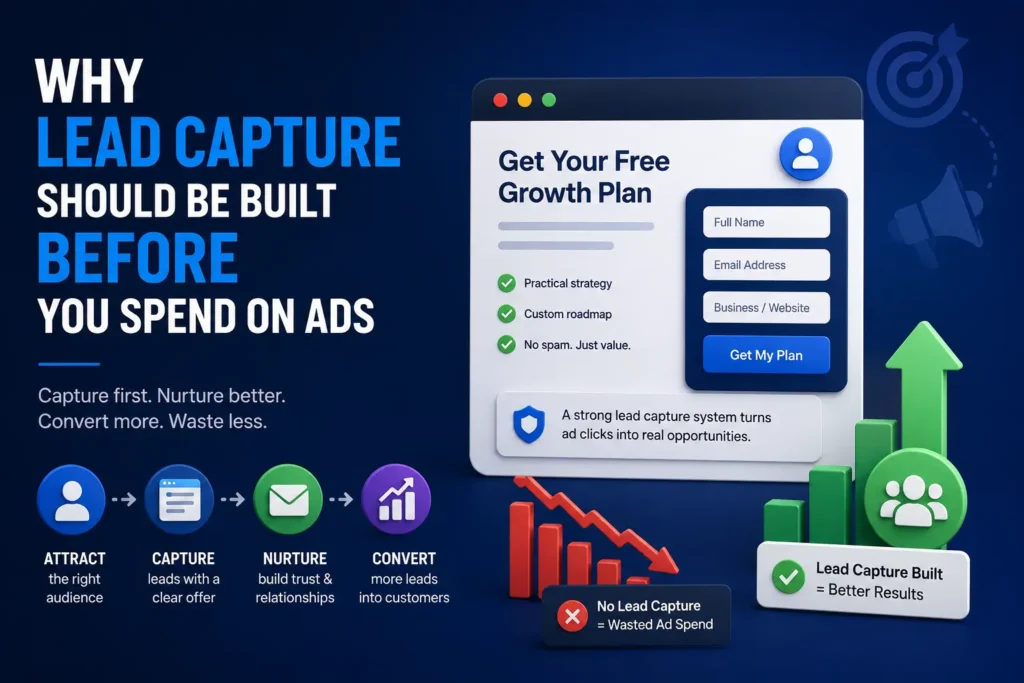
Before you spend heavily on ads, you need a lead capture system.
What Lead Capture Actually Means
Lead capture is the process of turning visitor interest into a useful business enquiry.
It is not just a contact form.
A proper lead capture system helps you understand:
- Who contacted you
- What they need
- Which page or campaign brought them
- How serious they are
- What should happen next
- Who should follow up
- Whether the lead came from search, social, referral, WhatsApp or paid ads
A form is only one part of the system.
A lead capture system includes the page, the call to action, the form, the confirmation message, the storage of the lead, the source tracking and the follow-up path.
If these pieces are missing, paid ads may bring traffic but not enough business value.
Why Ads Alone Do Not Solve Growth
Ads are useful when the offer, page and follow-up system are ready.
But ads cannot fix unclear positioning.
They cannot fix a confusing landing page.
They cannot fix weak proof.
They cannot fix a form that nobody wants to fill.
They cannot fix a business that does not respond quickly to enquiries.
Ads amplify what already exists.
If the system is clear, ads can accelerate results.
If the system is unclear, ads can accelerate waste.
This is why a business should not ask only, “How much should we spend on ads?”
It should first ask, “Where will the traffic go, and what should happen after someone clicks?”
The Real Journey After Someone Clicks an Ad
A visitor rarely becomes a lead only because they clicked an ad.
After the click, they usually ask a series of silent questions.
Is this relevant to me?
The page should immediately confirm that the visitor is in the right place.
If the ad promises one thing but the page talks about many things, the visitor gets confused.
Can I understand the offer quickly?
People do not read everything. They scan.
The headline, subheadline, sections and CTA should make the offer easy to understand.
Can I trust this business?
The page should show enough credibility.
This can include work examples, testimonials, founder credibility, process explanation, numbers, screenshots or relevant proof.
What should I do next?
The next step should be obvious.
If the visitor has to search for the button, form or WhatsApp link, the page is losing opportunities.
What happens after I submit?
People hesitate when they do not know what will happen next.
A simple line like “We will review your requirement and respond with the next useful step” can reduce uncertainty.
What Happens When Lead Capture Is Weak
A weak lead capture system creates silent leakage.
You may not notice it immediately because the traffic numbers look fine.
But the business loses opportunities in many small ways.
Visitors arrive but do not understand the offer.
Interested people do not find the right CTA.
Forms ask too much information too soon.
WhatsApp buttons open without context.
Leads enter email inboxes without source details.
Nobody knows which page generated the enquiry.
Follow-up is delayed.
The same generic reply goes to every lead.
No one tracks which leads converted.
When this happens, the business may blame the ads.
But the real issue is that the path from interest to enquiry is broken.
Build the Lead Capture Path Before the Campaign
Before launching ads, the page should answer three practical questions.
Where will the visitor land?
The destination should match the campaign.
If the ad is about one service, send the visitor to a focused landing page or a strong service page. Do not send them to a generic homepage unless the homepage is designed for that journey.
What action should the visitor take?
Choose one primary action.
It could be:
- Submit an enquiry
- Book a call
- Request a quote
- Download a guide
- Send a WhatsApp message
- Register for a webinar
- Request a review
Do not give too many options at the same priority.
How will the business follow up?
A lead is not complete when the form is submitted.
You need a follow-up process.
Who receives the lead? How quickly will they respond? What information should they send? How will the lead be tagged? Where will it be stored?
These decisions should be made before traffic starts coming in.
What a Practical Lead Capture System Includes
A useful lead capture system does not need to be complex. It needs to be clear.
1. A focused page
The page should explain one offer or one clear business problem.
It should avoid unnecessary distractions.
2. A strong call to action
The CTA should tell people what to do next.
Examples:
- Request a Website Review
- Discuss Lead Capture
- Get a Landing Page Plan
- Share Your Requirement
- Book a Discovery Call
3. A simple form
The form should collect enough information to qualify the lead, but not so much that it creates friction.
A practical first form can ask for:
- Name
- Business name
- Email or WhatsApp number
- Primary need
- Brief message
4. Source tracking
The business should know where the enquiry came from.
This helps compare ads, SEO, social, referrals and campaigns.
5. Lead storage
Leads should not disappear into inboxes.
They should be stored in a simple system such as a WordPress leads table, CRM, spreadsheet or database.
6. Follow-up workflow
The team should know what to do after the lead arrives.
A clear follow-up process is often more valuable than more traffic.
Why Landing Pages and Lead Capture Work Together
A landing page is often the best place to run paid traffic.
But the landing page must be connected to lead capture.
A landing page creates focus.
Lead capture turns that focus into a business opportunity.
For example, a landing page may explain a service. But the lead capture system asks the right questions, stores the enquiry and helps the business respond properly.
Without lead capture, the landing page is incomplete.
Without a focused page, the lead capture form may not get enough qualified enquiries.
Both should work together.
Why Lead Quality Matters More Than Lead Volume
Many businesses ask for more leads.
But more leads are not always better.
A business needs better-fit leads.
A weak campaign may generate many low-quality enquiries. These enquiries take time, create confusion and may not convert.
A better lead capture system can improve quality by asking the right questions.
For example:
- What service do you need?
- What is your timeline?
- Do you have an existing website?
- What problem are you trying to solve?
- What is the best way to contact you?
These questions help the business understand intent.
The goal is not to make the form difficult.
The goal is to collect enough context to respond intelligently.
How to Know If Your Business Is Ready for Ads
Before spending on ads, check the basics.
Your offer is clear
You should know exactly what you are promoting.
If the offer is vague, the campaign will be weak.
Your landing page is focused
The page should match the ad and explain the offer clearly.
Your proof is visible
The visitor should see why they can trust you.
Your CTA is obvious
The next step should be easy to find and easy to understand.
Your form works
Test the form before sending traffic.
Your leads are stored
Make sure every enquiry is saved somewhere.
Your follow-up is ready
Know who will respond and what they will say.
If these basics are not ready, pause the ad campaign and fix the system first.
A Simple Pre-Ad Checklist
Before launching ads, ask these questions:
- What exact offer are we promoting?
- Who is the ideal audience?
- Which page will the ad send people to?
- Does the page match the ad promise?
- Is the CTA clear?
- Is the form short and useful?
- Does WhatsApp open with proper context?
- Are leads stored safely?
- Do we know the source of each lead?
- Who will follow up?
- How fast will we respond?
- How will we measure lead quality?
If the answers are unclear, spending more money on ads may not help.
The Better Sequence
For most businesses, the better sequence is simple.
First, clarify the offer.
Then build the page.
Then create the lead capture path.
Then test the form.
Then prepare follow-up.
Then spend on ads.
This sequence reduces waste.
It also gives the business a better chance of learning from real traffic.
When the system is ready, ads become useful.
When the system is not ready, ads become expensive guesswork.
Final Takeaway
Ads can bring attention.
But attention only becomes valuable when the business knows how to capture, qualify and follow up with it.
Before you spend on ads, build the lead capture system.
Create a focused page.
Make the CTA clear.
Keep the form simple.
Track where leads come from.
Store enquiries properly.
Respond quickly.
A good ad campaign starts before the ad is launched.
It starts with the system that receives the traffic.
Need Help Building a Lead Capture System?
If your website gets visitors but enquiries are unclear, Design Wiz Tech can help you create a practical lead capture path.
Share your current website, landing page or campaign plan. We will suggest the smallest useful improvement.