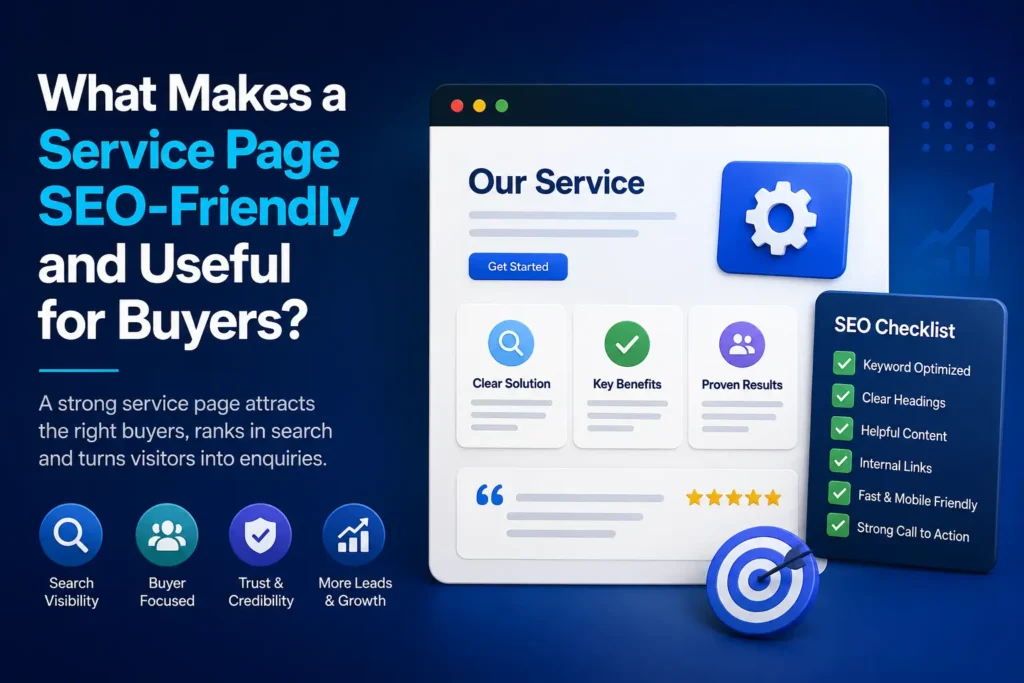
A service page has two jobs.
It should help search engines understand what the page is about.
It should also help real buyers understand whether the service is right for them.
Many businesses focus on only one side.
Some pages are written for SEO but feel unnatural to read. They repeat keywords, add generic sections and fail to answer real buyer questions.
Other pages are written nicely but do not give search engines enough structure. The service is unclear, headings are vague and important search terms are missing.
A strong service page needs both.
It should be search-friendly and buyer-friendly.
That means it should be clear, specific, structured and useful.
A Service Page Is a Decision Page
A service page is not just a description of what your business offers.
It is a decision page.
A visitor comes to a service page because they are trying to understand something.
They may be asking:
- Is this the service I need?
- Does this business understand my problem?
- What exactly is included?
- How does the process work?
- Can I trust them?
- What should I do next?
If the page answers these questions well, the visitor is more likely to continue.
If the page stays vague, the visitor may leave even if the design looks good.
SEO can bring people to the page.
But clarity, proof and usefulness help them stay.
Why Generic Service Pages Do Not Work
Many service pages sound similar.
They use lines like:
- We provide high-quality solutions
- We help businesses grow
- We offer end-to-end services
- We use the latest technology
- We deliver measurable results
These statements are not always wrong. But they are too broad.
They do not explain the specific service.
They do not show who it is for.
They do not answer buyer questions.
They do not create trust.
A generic service page is weak for SEO because search engines cannot clearly understand the topic. It is also weak for buyers because the page does not help them make a decision.
The page must be specific.
Start With Buyer Intent
A good service page begins with buyer intent.
Buyer intent means understanding why someone is searching for this service.
For example, someone searching for “landing page design services” may want:
- A page for one campaign
- A better page for paid ads
- A product launch page
- A lead generation page
- A webinar registration page
- A service offer page
Someone searching for “SEO content pages” may want:
- Service pages that rank
- Blog posts that answer buyer questions
- Topic clusters
- FAQ sections
- Internal linking support
- Content that supports enquiries
If you understand the intent, the page becomes easier to write.
You can speak to the real problem instead of filling the page with generic copy.
Use a Clear H1
The H1 should clearly describe the service.
It should not be too clever.
For example:
Good H1:
Landing Page Design Services for Campaigns, Offers and Lead Generation
Weak H1:
Design That Converts
The second version may sound stylish, but it is not specific enough.
A clear H1 helps both readers and search engines.
It tells the visitor exactly what the page is about.
Write a Useful Opening Section
The opening section should quickly explain the service.
It should answer:
- What is this service?
- Who is it for?
- What problem does it solve?
- What outcome does it support?
The opening should not be overloaded with keywords.
It should be simple and human.
For example:
A useful service page opening might say:
“Our landing page design service helps businesses create focused pages for campaigns, offers, launches and lead generation. Each page is structured around one audience, one offer and one clear action.”
That is better than saying:
“We are the best landing page design company offering world-class landing page design solutions for all businesses.”
The first version is useful.
The second version sounds like SEO filler.
Explain the Problem Before the Service
Buyers often need to feel understood before they care about the solution.
A good service page should explain the problem the service solves.
For example, a lead capture page can explain:
Many websites get visitors but do not capture enquiries clearly. Forms are hidden, CTAs are vague, WhatsApp links have no context and leads are not stored properly.
This makes the problem visible.
Then the service makes sense.
If the page jumps straight into “what we offer,” it may feel too sales-focused.
A better page first shows that the business understands the buyer’s situation.
Show What Is Included
A service page should make the offer concrete.
Do not only say “complete solution” or “end-to-end service.”
Explain what is included.
For example, a website design service may include:
- Homepage structure
- Service pages
- About or proof section
- Contact page
- Lead form
- Mobile layout
- SEO-ready page structure
- Basic performance setup
- Internal linking
- Launch support
A buyer should know what they are getting.
Specific inclusions reduce uncertainty.
They also create useful SEO content naturally because the page covers related terms and concepts.
Explain Who the Service Is For
A service page should not try to speak to everyone.
It should identify the right audience.
For example:
This service is useful for:
- Service businesses
- Consultants
- Clinics
- Agencies
- B2B companies
- Local businesses
- Founder-led brands
- Digital product creators
This helps buyers self-qualify.
It also helps the page rank for more relevant long-tail searches.
A page that clearly says who it serves is often stronger than a page that tries to appeal to everyone.
Add Proof Without Overclaiming
Proof is important, but it should be honest.
You do not always need big case studies.
You can show proof through:
- Project references
- Screenshots
- Before and after examples
- Process explanation
- Client categories
- Published work
- Founder experience
- Sample outputs
- Testimonials
- Measurable improvements where available
Avoid fake claims.
Do not say “we increased revenue by 500%” unless you can prove it.
A credible service page is specific without exaggeration.
Trust matters more than hype.
Use FAQs to Answer Buyer Questions
FAQs are useful for both SEO and conversion.
They help answer questions that buyers may not ask directly.
For example, a website design service page can include FAQs like:
How long does a business website take to build?
Answer honestly based on your process.
Do I need all pages at once?
Explain whether the business can start with a smaller version.
Will the website be SEO-ready?
Explain what SEO-ready means at the page-structure level.
Can landing pages be added later?
Show how the website can grow.
Do you also help with lead capture?
Connect the service to forms, WhatsApp and enquiry paths.
FAQs help the buyer feel informed.
They also create natural search-friendly content.
Build Internal Links
A good service page should connect to related pages.
For example, a website design service page can link to:
- Landing page design services
- SEO content pages
- Lead capture systems
- UI/UX design services
- Work or proof
- Contact page
- Relevant blog articles
Internal links help visitors continue their journey.
They also help search engines understand the relationship between pages.
A service page should not be isolated.
It should be part of a larger website system.
Make the CTA Specific
A service page should end with a clear next step.
Generic CTAs like “Submit” or “Contact Us” are not always strong enough.
Use a CTA that matches the service.
Examples:
- Request a Website Review
- Discuss a Landing Page
- Plan SEO Content Pages
- Build a Lead Capture Path
- Share Your Requirement
- Ask for a Practical Next Step
The CTA should reduce hesitation.
It should tell the visitor what action they are taking.
Keep the Page Easy to Scan
SEO-friendly does not mean long and dense.
A service page can be detailed but still easy to read.
Use:
- Clear headings
- Short paragraphs
- Useful bullet points
- Simple section structure
- Specific examples
- Internal links
- FAQs
- A clear CTA
Avoid:
- Keyword stuffing
- Long blocks of text
- Generic claims
- Too many competing CTAs
- Unclear service descriptions
- Overloaded design sections
People scan before they read.
If the page is hard to scan, it will lose buyers.
Suggested Service Page Structure
A strong SEO-friendly service page can follow this structure.
H1: Clear service title
Say what the service is.
Opening section
Explain who it is for and what problem it solves.
Problem section
Describe what buyers are struggling with.
What we build or provide
List the actual service components.
Who it is best for
Help the visitor self-identify.
Process section
Explain how the work happens.
Proof section
Show references, work, examples or credibility.
FAQs
Answer common buyer questions.
CTA
Invite the visitor to take the next useful step.
This structure works because it serves both search intent and buyer decision-making.
SEO Elements to Add
A service page should also include basic SEO elements.
SEO title
The SEO title should include the service and business context.
Example:
Landing Page Design Services for Campaigns and Lead Generation
Meta description
The meta description should explain the page in a useful way.
Example:
Design Wiz Tech creates focused landing pages for campaigns, offers, lead generation, webinars and digital products with clear copy, CTA and lead capture paths.
Slug
The URL should be simple.
Example:
/landing-page-design-services/
Image alt text
Images should describe the visual and the service context.
Schema
Where possible, service pages can use structured data such as Organization, WebPage, Service or FAQ schema.
Even without advanced schema, the page should be clean, readable and logically structured.
What Makes a Service Page Truly Useful
A useful service page does not only rank.
It helps the buyer think.
It makes the offer clearer.
It reduces confusion.
It answers questions.
It builds trust.
It shows what happens next.
This is what separates a real service page from a keyword page.
A keyword page is written to attract traffic.
A useful service page is written to convert the right traffic into a serious enquiry.
The best pages do both.
Final Takeaway
A service page should not be written only for search engines.
It should be written for buyers who are trying to make a decision.
Make the page clear.
Make the service specific.
Explain the problem.
Show what is included.
Add proof.
Answer FAQs.
Use internal links.
Make the CTA obvious.
When a service page is useful for buyers, it becomes stronger for SEO too.
Search engines reward pages that clearly satisfy intent.
Buyers reward pages that reduce confusion and build trust.
A good service page should do both.
Need Help Creating SEO-Friendly Service Pages?
If your service pages are unclear, thin or not generating enough enquiries, Design Wiz Tech can help structure them better.
Share your current page or service offer. We will suggest the smallest useful improvement.