AI Jobs in India 2026: Fastest-Growing Roles, Non-Coding Careers and Skills Employers Want
AI jobs in India are changing fast. Here is a practical guide to the fastest-growing AI roles, non-coding AI careers, skills employers want and what professionals, freelancers and small businesses should do next.
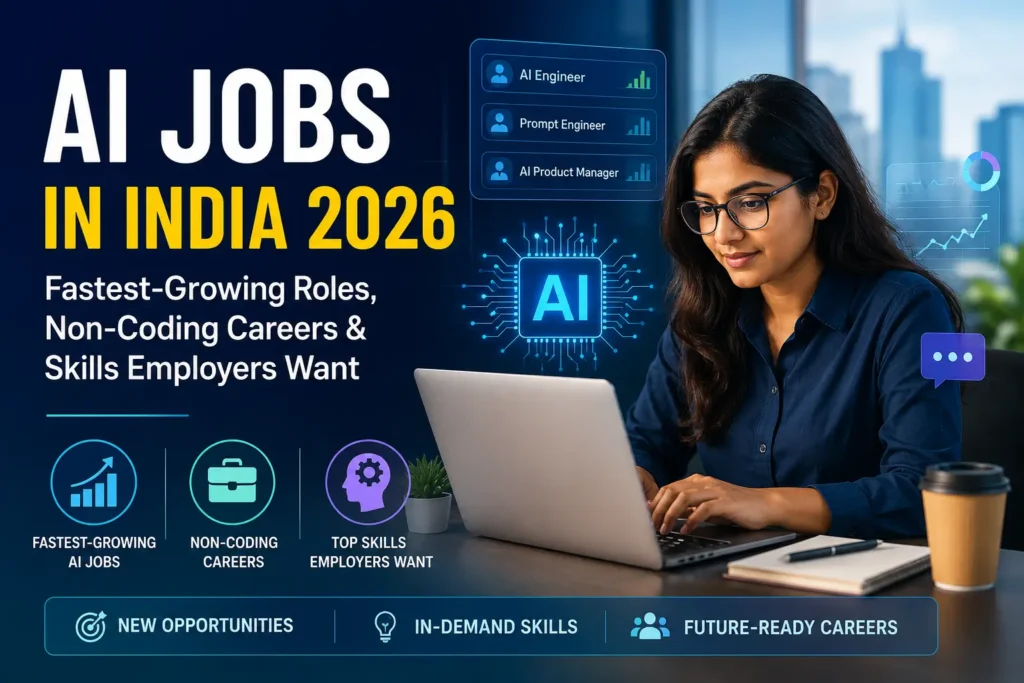
Artificial intelligence is no longer only a technology topic. It has become a career, business and survival question.
Students are asking whether AI will reduce entry-level jobs. Working professionals are asking which skills they should learn. Freelancers are asking how to stay valuable. Small business owners are asking whether AI can help them reduce cost, create content, improve marketing and generate more leads.
The honest answer is this: AI is not only replacing jobs. It is changing job descriptions.
Some tasks will reduce. Some roles will disappear. But new roles are also opening up around AI engineering, data, product, automation, content, customer support, compliance, design, marketing and business operations.
For India, the opportunity is serious because companies need people who understand both AI tools and real business problems. You do not always need to become a coder to benefit from AI. But you do need AI fluency, better judgement, stronger digital skills and the ability to use tools in practical workflows.
Quick Answer: What Is Changing in AI Jobs in India?
AI is creating three kinds of career shifts in India.
- Technical AI roles are growing: AI Engineer, Machine Learning Engineer, Data Scientist, MLOps Engineer, Generative AI Engineer and AI Agents Developer are becoming important roles in technology teams.
- Non-coding AI roles are opening up: AI Product Manager, AI Solutions Consultant, AI Content Strategist, AI Customer Support Associate, AI Ethicist, Analytics Translator and Prompt Engineer are useful for people from business, content, design, operations, HR and consulting backgrounds.
- Everyday jobs are becoming AI-assisted: Marketing, sales, design, writing, HR, teaching, finance, customer support and small business operations are already using AI tools to save time and improve output.
This means the better question is not only, “Will AI take my job?”
The better question is, “How can I use AI to become more useful, faster and more valuable in my role?”
Why AI Jobs Are Growing in India
AI adoption is increasing because businesses want faster content, better customer support, better data analysis, smarter automation and lower operating costs.
Global job-market reports suggest that AI and automation will create both disruption and new opportunities. The World Economic Forum’s Future of Jobs Report 2025 projected that 170 million new jobs may be created by 2030, while 92 million may be displaced. That gives a net increase of 78 million jobs, but only for people and businesses that adapt.
PwC’s 2025 AI Jobs Barometer also reported that workers with AI skills are earning a significant wage premium. This does not mean every AI course will lead to a high salary. It means employers are willing to pay more for people who can use AI to create measurable business value.
In India, this matters because businesses are still digitising. Many companies do not only need AI researchers. They need practical people who can use AI in websites, SEO content, sales funnels, customer communication, reporting, lead generation and business workflows.
What AI Job Titles Are Growing Fastest in India in 2026?
Here are some AI-linked roles that are getting stronger attention in India’s job market. Salary ranges vary widely by company, location, experience and skill level, so treat any salary number as indicative, not guaranteed.
1. AI Engineer
AI Engineer is one of the most visible AI job titles in India. This role usually involves building, integrating or improving AI systems. It often requires Python, machine learning basics, APIs, cloud knowledge and experience with AI models or tools.
Best fit for: software developers, data professionals, engineering graduates and tech professionals who want to move deeper into AI systems.
2. Machine Learning Engineer
Machine Learning Engineers build and improve models that can learn from data. They often work with Python, TensorFlow, PyTorch, data pipelines, model training and deployment.
Best fit for: people with strong technical foundations, mathematics comfort and real project experience.
3. Data Scientist
Data Scientist remains a strong AI-adjacent role because AI depends on data. Data Scientists analyse data, build models, identify patterns and help businesses make decisions.
Best fit for: people who like statistics, business analysis, Python, SQL and problem-solving.
4. Generative AI Engineer
Generative AI Engineers work with large language models, image models, chatbots, AI assistants and content-generation systems. This role has grown because companies now want internal AI tools, knowledge assistants and automation systems.
Best fit for: developers who understand APIs, LLMs, prompt design, retrieval systems and business use cases.
5. Prompt Engineer
Prompt Engineering became popular after the rise of tools like ChatGPT, Claude, Gemini and other AI assistants. But the role is changing. It is no longer only about writing clever prompts. It now involves understanding workflows, context, output quality, testing, automation and business outcomes.
Best fit for: writers, analysts, marketers, product people, trainers, automation specialists and domain experts who can communicate clearly with AI systems.
6. AI Product Manager
An AI Product Manager connects business goals, user needs and AI capabilities. This role does not always require coding, but it does require enough AI understanding to work with technical teams and make product decisions.
Best fit for: product managers, business analysts, founders, consultants, project managers and people with domain knowledge.
7. MLOps Engineer
MLOps Engineers help deploy and maintain machine learning systems in production. This is a more technical role and is important because many AI models fail when they move from demo to real-world usage.
Best fit for: cloud engineers, DevOps professionals, backend developers and ML engineers.
8. AI Agents Developer
AI Agents Developers build automated systems that can complete multi-step tasks using AI tools, APIs and workflows. This area is likely to grow as companies try to automate repetitive business processes.
Best fit for: developers, automation specialists, workflow builders and people comfortable with APIs and tools like n8n, Make, Zapier and custom scripts.
9. NLP Engineer
NLP Engineers work on language-related AI systems such as chatbots, search, voice interfaces, translation, summarisation and text classification.
Best fit for: people interested in language, data, machine learning and conversational AI.
10. AI Ethics and Compliance Specialist
As AI adoption grows, companies will need people who understand responsible AI, privacy, bias, compliance, governance and risk. This is especially relevant for regulated sectors such as finance, healthcare, education and enterprise technology.
Best fit for: law, policy, HR, compliance, research, governance and business professionals who can understand AI impact without necessarily building the model.
Which Non-Coding AI Jobs Are Easiest to Enter?
Not every AI job requires coding. Some roles need business judgement, communication, workflow understanding, content sense, design thinking, compliance awareness or domain knowledge.
For non-coders, the easiest entry points are usually not the highest-paying roles from day one. They are the roles where you can show practical AI usage, build small projects and improve existing work.
1. Data Annotator or AI Data Trainer
This is one of the easiest entry points for freshers. Data annotators help label, check, organise or improve data used by AI systems. AI data trainers may help improve model responses, evaluate outputs or correct errors.
Entry barrier: Low
Skills needed: attention to detail, basic computer skills, language ability, consistency and quality checking
Good for: freshers, graduates, language specialists and people looking for first AI exposure
2. AI Customer Support Associate
Many customer support teams are now using AI chatbots, helpdesk automation and response suggestions. AI Customer Support Associates handle complex issues, monitor AI responses and improve support workflows.
Entry barrier: Low
Skills needed: communication, customer handling, tool usage, problem-solving and escalation judgement
Good for: BPO professionals, support executives, freshers and operations teams
3. AI Content Strategist
AI has changed content production. But businesses still need humans who can decide what to write, what to verify, what to publish, how to structure SEO content and how to maintain quality.
Entry barrier: Low to medium
Skills needed: writing, editing, SEO basics, prompt engineering, fact-checking and brand understanding
Good for: writers, editors, marketers, bloggers, SEO professionals and content creators
4. Prompt Engineer
Prompt engineering can be a non-coding entry point, but it should not be treated as magic. The valuable version of prompt engineering is the ability to create reliable workflows, improve outputs and solve business problems using AI tools.
Entry barrier: Low to medium
Skills needed: clear writing, structured thinking, testing, domain knowledge and output evaluation
Good for: content professionals, marketers, trainers, consultants, analysts and automation beginners
5. AI Product Manager
AI Product Managers decide what AI feature should be built, why users need it, how it should work and how success will be measured. They work with engineers, designers, business teams and customers.
Entry barrier: Medium
Skills needed: product thinking, user research, business understanding, AI basics and communication
Good for: product managers, business analysts, startup founders, consultants and project managers
6. AI Solutions Consultant
AI Solutions Consultants understand a business problem and recommend practical AI-enabled solutions. For example, a company may want to automate lead follow-ups, summarise customer calls, improve website content or create internal knowledge search.
Entry barrier: Medium
Skills needed: business analysis, communication, AI tool awareness, workflow mapping and presentation skills
Good for: consultants, sales engineers, agency owners, business developers and digital professionals
7. AI UX or AI Design Specialist
AI products still need good user experience. AI UX specialists help design interfaces where users can interact with AI clearly, safely and efficiently.
Entry barrier: Medium
Skills needed: UX design, user flows, prototyping, AI interaction patterns, copy clarity and usability testing
Good for: designers, product designers, UX writers and researchers
8. Analytics Translator
An Analytics Translator connects data teams with business teams. The role is to convert technical insights into business decisions.
Entry barrier: Low to medium
Skills needed: data literacy, communication, business context, presentation and problem-solving
Good for: managers, analysts, consultants, MBAs and domain specialists
9. AI Ethicist or Responsible AI Associate
This role focuses on responsible AI use, fairness, bias, privacy and governance. It is not the easiest role for freshers, but it is a good path for people from law, policy, HR, research, compliance and social sciences.
Entry barrier: Medium
Skills needed: ethics, policy, risk analysis, compliance, communication and basic AI understanding
Good for: legal, policy, compliance, HR and governance professionals
What Skills Are Employers Asking for in AI Roles?
Employer expectations depend on the type of role. A technical AI role requires coding and model knowledge. A non-coding AI role requires tool fluency, business understanding and the ability to apply AI in a real workflow.
Technical Skills for AI Roles
- Python: Still one of the most important programming languages for AI and data work.
- SQL: Useful for querying and understanding data.
- Data handling: Cleaning, organising and interpreting data is essential before AI can be useful.
- Machine learning basics: Understanding models, training, testing, accuracy and failure cases.
- TensorFlow or PyTorch: Useful for machine learning and deep learning roles.
- APIs: Important for connecting AI tools with websites, apps and business systems.
- Cloud platforms: AWS, Azure or Google Cloud knowledge helps in deployment and scaling.
- LLMs: Understanding large language models, their strengths, limits and use cases.
- RAG: Retrieval-Augmented Generation helps AI systems answer from company documents or knowledge bases.
- MLOps: The ability to deploy, monitor and maintain AI systems in real use.
Non-Technical Skills for AI Roles
- Prompt engineering: The ability to give clear instructions, context and examples to AI tools.
- AI fluency: Knowing what AI can do, where it fails and how to use it responsibly.
- Communication: Explaining AI outputs, risks and decisions to non-technical people.
- Critical thinking: AI can produce confident but wrong answers. Human judgement is essential.
- Business understanding: Employers value people who can connect AI to revenue, cost, speed or quality.
- Domain knowledge: AI plus healthcare, finance, education, marketing, design, law or operations is more valuable than generic AI knowledge.
- Responsible AI awareness: Understanding privacy, bias, accuracy and ethical use.
- Portfolio building: A small working project is often more convincing than only completing courses.
Do You Need Coding to Get an AI Job?
The answer depends on the role.
If you want to become an AI Engineer, Machine Learning Engineer, Data Scientist, MLOps Engineer or Generative AI Engineer, coding is usually required. You will need Python, data skills, model knowledge and technical project experience.
If you want to work in AI product management, AI content, AI consulting, AI support, AI ethics, AI UX, analytics translation or AI-enabled business operations, coding may not be required in the beginning.
But even non-coding professionals need AI fluency. You should understand how AI tools work, how to create better outputs, how to verify results and how to apply AI inside a real business workflow.
AI Jobs for Different People
For Students
Students should focus on fundamentals. Do not only chase the latest tool. Learn digital basics, data literacy, AI concepts, communication and one practical project.
A good student project could be an AI-powered resume reviewer, a local business content planner, a chatbot for college FAQs or a simple data dashboard.
For Freshers
Freshers should not wait for the perfect AI job title. Start with roles that expose you to real workflows. Data annotation, AI support, content operations, SEO content, customer support automation and junior analyst roles can become stepping stones.
For Mid-Career Professionals
Mid-career professionals should not try to become fresh AI engineers overnight unless they are ready for serious technical learning. A better strategy is to combine existing experience with AI.
For example, a marketing manager can become an AI-enabled growth marketer. An HR professional can use AI for hiring workflows. A finance professional can use AI for reporting and analysis. A teacher can use AI for lesson planning and personalised learning support.
For Freelancers
Freelancers should use AI to improve speed, quality and packaging. Writers can offer SEO content systems. Designers can create faster concepts and brand assets. Developers can build AI-enabled landing pages. Consultants can offer AI workflow audits.
The opportunity is not only “use AI to do cheap work.” The better opportunity is to use AI to deliver clearer, faster and more useful outcomes.
For Small Business Owners
Small businesses may not need a full AI team. They need practical systems. AI can help them create website content, write FAQs, prepare social posts, improve lead follow-up, summarise customer queries, generate reports and build content calendars.
But AI tools alone are not enough. A business still needs a proper website, service pages, landing pages, lead forms, search-friendly content and a follow-up system.
The Real Opportunity: AI Plus Domain Knowledge
The most valuable professionals will not be people who only know AI tools. The most valuable professionals will combine AI with domain knowledge.
- AI plus marketing: better campaigns, faster content, sharper audience research and improved lead capture.
- AI plus design: faster ideation, better UX testing, improved visual systems and cleaner prototypes.
- AI plus finance: reporting, forecasting, reconciliation and document analysis.
- AI plus education: lesson planning, student support, practice material and personalised feedback.
- AI plus healthcare: patient communication, documentation, scheduling and awareness content.
- AI plus local business: websites, SEO pages, WhatsApp follow-ups, offers, reviews and customer support.
This is where many Indian professionals and small businesses can win. You do not need to build the next OpenAI. You need to solve a real business problem using AI, content, design and digital systems.
How Small Businesses Can Use AI Without Hiring a Big Tech Team
Most small businesses do not need complicated AI products. They need better digital execution.
Here are practical areas where AI can help:
- Website content: creating clearer service pages, about pages, FAQs and landing page copy.
- SEO content: planning search-friendly articles around buyer questions.
- Landing pages: creating focused pages for campaigns, offers and lead generation.
- Lead capture: improving forms, CTAs and enquiry flows.
- WhatsApp follow-up: creating structured responses, reminders and lead qualification scripts.
- CRM workflows: organising leads, status, source and next steps.
- Content calendars: planning weekly content for blogs, LinkedIn, Instagram and newsletters.
- Business automation: reducing repetitive work in reporting, emails, summaries and documentation.
The real value comes when these pieces work together. A website without lead capture is incomplete. AI content without SEO structure is weak. Automation without a business process creates confusion.
How Design Wiz Tech Can Help
Design Wiz Tech helps businesses build practical digital systems, not just attractive websites.
If you are a small business owner, consultant, service provider, founder, creator or local brand, AI can support your growth. But you still need the right digital foundation.
Design Wiz Tech can help with:
- AI-ready websites that explain your services clearly
- SEO content pages built around real customer searches
- Landing pages for campaigns, ads and offers
- Lead capture forms and enquiry flows
- Website content and blog systems
- Simple automation for follow-ups and workflows
- Publishing systems for businesses that need regular content
- Digital growth assets for professionals and small teams
AI is useful. But AI works better when your website, content, lead capture and business process are already organised.
If your business wants to use AI but does not know where to start, begin with the basics: your website, your service pages, your content, your lead flow and your follow-up system.
FAQs on AI Jobs in India 2026
Will AI take my job?
AI may reduce some repetitive tasks, but it will also create new work around AI tools, data, automation, product management, content, compliance and business workflows. The safest strategy is to learn how AI affects your current role and start using it practically.
Which AI job is best without coding?
Some of the best non-coding AI roles include AI Product Manager, AI Solutions Consultant, AI Content Strategist, AI Customer Support Associate, AI Ethicist, Analytics Translator and Prompt Engineer.
What is the easiest AI job for freshers?
Data annotation, AI data training, AI-assisted customer support, junior content operations and AI tool-based marketing support can be easier entry points for freshers.
Is prompt engineering still useful?
Yes, but only if it goes beyond simple prompts. Useful prompt engineering now means creating repeatable workflows, improving output quality, testing results and applying AI to real business problems.
What AI skills should I learn first?
Start with AI fluency, prompt engineering, data literacy and practical tool usage. If you want a technical AI role, add Python, SQL, machine learning basics, APIs, cloud and LLM concepts.
Can I get an AI job without a technical degree?
Yes, for some roles. Non-coding AI roles value communication, business understanding, content judgement, product thinking, domain knowledge and practical AI tool usage. Technical roles still usually require stronger coding and data skills.
Can small businesses use AI without developers?
Yes. Small businesses can use AI for content, SEO planning, customer support, lead follow-up, reporting, social media and workflow automation. But they still need a clear website, landing pages, lead capture and a proper follow-up process.
Final Takeaway
AI will not reward everyone equally. It will reward people and businesses that learn how to use it with judgement.
For professionals, the next step is to combine AI fluency with your current domain. For freelancers, the next step is to package AI-enabled services around clear business outcomes. For small businesses, the next step is to use AI inside a proper digital growth system.
The future is not only about AI replacing work. It is about better people, better teams and better businesses using AI to work smarter.
Sources and Further Reading
- World Economic Forum, Future of Jobs Report 2025: https://www.weforum.org/
- PwC, 2025 AI Jobs Barometer: https://www.pwc.com/gx/en/services/ai/ai-jobs-barometer.html
- IndiaAI, Seven Interesting AI Jobs That Do Not Require Coding: https://indiaai.gov.in/article/seven-interesting-ai-jobs-that-do-not-require-coding
- Coursera, Artificial Intelligence Jobs: https://www.coursera.org/in/articles/artificial-intelligence-jobs
- Deloitte and NASSCOM AI talent research: https://www.deloitte.com/in/
Read next
Landing Page Checklist: What Every Campaign Page Should Include
A landing page should focus one audience on one clear action. This checklist explains what every campaign page needs before you send paid traffic, email clicks, social visitors or WhatsApp leads to it.
Read article
What Makes a Service Page SEO-Friendly and Useful for Buyers?
A strong service page should not be written only for search engines. It should help buyers understand the service, compare options, trust the business and take the next step. Here is what makes a service page both SEO-friendly and useful.
Read article
Why Lead Capture Should Be Built Before You Spend on Ads
Before spending on ads, a business should know how it will capture, qualify and follow up with leads. Without a clear lead capture system, paid traffic can create attention without turning it into useful enquiries.
Read article