Website vs Landing Page: Which One Does Your Business Need First?
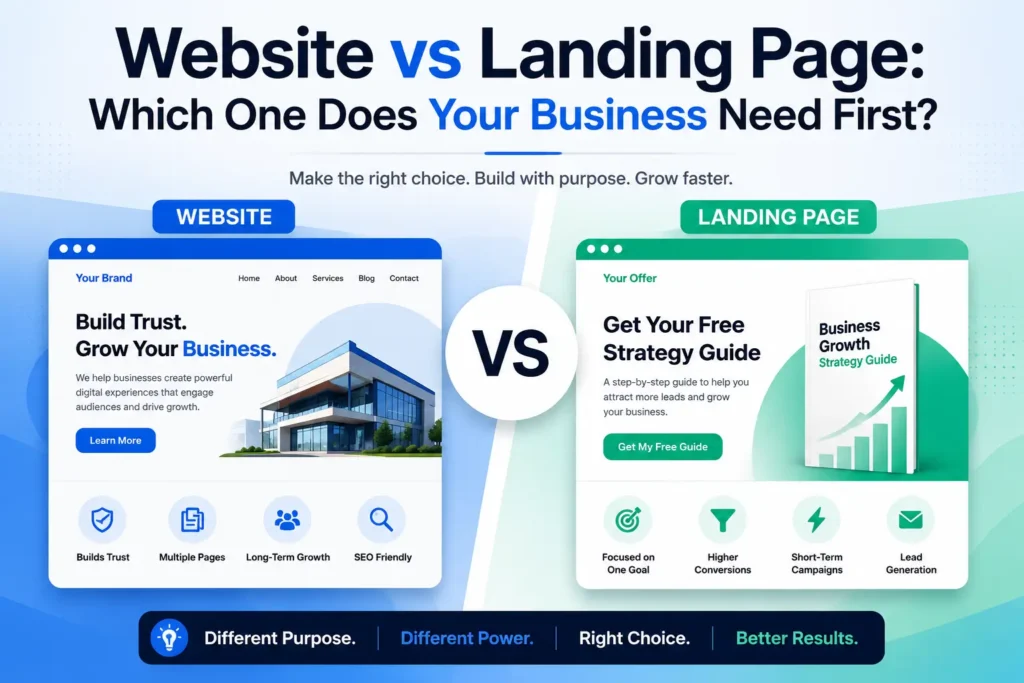
A website and a landing page are not the same thing. A website builds trust, explains your business and supports long-term discovery. A landing page focuses one audience on one action. Here is how to decide which one your business needs first.
Most businesses know they need a better online presence. But the first decision is often unclear.
Should you build a full website?
Or should you start with one focused landing page?
This sounds like a small technical choice. It is not. It affects your budget, timeline, marketing, lead quality and the way potential buyers understand your business.
A website and a landing page are both useful. But they solve different problems.
A website helps people understand your business.
A landing page helps people take one specific action.
If you choose the wrong one first, you may spend weeks building pages nobody needs. Or you may send traffic to a one-page offer before people trust you enough to inquire.
The smarter approach is to ask one question first:
What is the immediate business problem this page needs to solve?
What a Website Is Actually For
A website is your business base.
It is where people go when they want to understand who you are, what you do, who you serve, how credible you are and how to contact you.
A good business website usually includes:
- Homepage
- Services
- About page
- Work or proof
- Contact page
- Blog or insights section
- Lead capture path
A website is useful when the buyer needs context before taking action.
For example, a clinic, consultant, agency, school, B2B company, local service provider or expert-led business usually needs more than one page. People want to check credibility. They want to see the range of services. They want to understand the people behind the business. They may compare you with other options.
A full website is not just a design asset. It is a trust asset.
It answers questions like:
- What does this business do?
- Is this relevant to me?
- Can I trust them?
- What services do they offer?
- Have they done similar work before?
- How do I contact them?
- What should I read next?
If your business is hard to understand, your website has a clarity problem.
If visitors are coming but not contacting you, your website may have a trust or conversion problem.
If your services are buried in vague copy, your website has a positioning problem.
A website is the right first step when your business needs a stronger foundation.
What a Landing Page Is Actually For
A landing page is not a smaller website.
It is a focused decision path.
A landing page is built for one audience, one offer and one action.
That action could be:
- Book a consultation
- Download a guide
- Register for a webinar
- Buy a digital product
- Inquire about one service
- Join a waitlist
- Request a quote
A landing page works best when the visitor already has a clear reason to be there.
For example, if you are running an ad for a specific service, you do not want to send people to your homepage and make them search. You want to send them to a page that speaks directly to that offer.
A good landing page answers:
- What is being offered?
- Who is it for?
- Why does it matter now?
- What problem does it solve?
- What proof supports it?
- What happens after I submit the form?
- What should I do next?
A landing page removes distractions.
It does not need a large menu. It does not need every service. It does not need your entire company history. It needs enough clarity and trust to move the right person toward one action.
This is why landing pages are useful for campaigns.
They are easier to test, easier to improve and easier to connect with ads, email, WhatsApp or social media.
The Simplest Difference Between a Website and a Landing Page
Here is the practical difference:
A website helps people understand the business.
A landing page helps people act on one offer.
A website is a base.
A landing page is a campaign path.
A website supports trust, search and long-term discovery.
A landing page supports conversion, testing and focused lead generation.
Both can generate leads. But they do it differently.
A website builds the environment where trust can grow.
A landing page creates a direct path for one specific action.
When Your Business Needs a Website First
Start with a website if your business has a broader credibility problem.
This is usually the case when:
- You do not have a professional online presence
- Your current website looks outdated
- Your services are not clearly explained
- People ask the same basic questions again and again
- Your business depends on trust before inquiry
- You want to build long-term SEO traffic
- You have multiple services or customer types
- You need a base for future content, campaigns and hiring
A website is especially important for service businesses.
If you are a consultant, agency, clinic, design studio, B2B firm, school, local service provider or expert, people will often check your website before contacting you.
They may first discover you on LinkedIn, Instagram, Google, WhatsApp or through a referral. But before they take the next step, many will still check your website.
If the website is weak, trust drops.
A strong website does not need to be complicated. But it should be clear.
At minimum, it should explain:
- What you do
- Who you serve
- What problems you solve
- What services you offer
- Why someone should trust you
- How to contact you
If those basics are missing, a landing page will not fully solve the problem.
When Your Business Needs a Landing Page First
Start with a landing page if you have one clear offer and need speed.
This is usually the case when:
- You are launching a specific service
- You are testing a new offer
- You are running ads
- You are promoting a webinar or event
- You are selling a digital product
- You are offering a free audit, checklist or consultation
- You need leads quickly but do not want to rebuild the whole website
- You want to validate demand before investing more
A landing page is useful when the offer is already clear.
For example:
- A dentist promoting a teeth whitening package
- A consultant offering a paid strategy session
- A software company promoting one feature-led demo
- A creator selling a template pack
- A real estate business promoting one project
- A training company collecting webinar registrations
In these cases, a full website may be too broad for the campaign.
A focused landing page can work better because it keeps attention on the offer.
What Happens When You Use the Wrong One
Many businesses make the mistake of using a homepage as a campaign page.
They run ads or share posts that send people to a generic homepage. The visitor arrives, sees many options and leaves without taking action.
The problem is not always traffic quality. The problem is often page focus.
On the other side, some businesses build landing pages before they have any credibility base.
A visitor likes the offer but wants to know more about the company. They click around and find nothing useful. No about page. No proof. No clear service details. No trust signals.
The landing page may get attention, but the business still feels thin.
This is why the choice matters.
A landing page without trust may feel risky.
A website without focus may feel confusing.
The best system often needs both, but not always at the same time.
A Practical Decision Framework
Use this simple framework.
Choose a Website First If:
- Your business is not clearly explained online
- You need credibility
- You have multiple services
- You want long-term SEO
- You want a professional base
- You expect people to research before contacting you
Choose a Landing Page First If:
- You have one specific offer
- You are running a campaign
- You need speed
- You want to test demand
- You want one clear call to action
- You are not ready for a full website rebuild
Build Both If:
- You already have a clear business base
- You are ready to run campaigns
- You want SEO and lead generation together
- You need service pages plus focused offer pages
- You want a repeatable digital growth system
The Best Sequence for Many Businesses
For many small and mid-sized businesses, the best sequence is:
- Build a clear website foundation.
- Create focused landing pages for specific campaigns.
- Connect both to a practical lead capture system.
- Improve the pages based on real traffic and inquiry quality.
The website becomes the trust base.
The landing pages become the conversion paths.
This gives you both long-term and short-term value.
Your website can support organic discovery, referrals and brand trust.
Your landing pages can support ads, launches, events, offers and lead magnets.
Together, they create a better digital system.
But if budget or time is limited, do not try to build everything at once. Start with the asset that solves the most urgent business problem.
What a Good Website Should Include
A practical business website should not be bloated.
It should include only what helps the buyer understand and act.
A useful first version can include:
- A homepage with clear positioning
- Service pages for your main offers
- An about page that builds trust
- A work, proof or case studies section
- A contact page with a simple form
- A blog or insights section for future SEO
- Clear calls to action across the site
The goal is not to impress everyone.
The goal is to make the right buyer think:
This is relevant to me.
This business understands the problem.
I can trust them enough to take the next step.
What a Good Landing Page Should Include
A landing page should be focused and easy to scan.
A useful landing page can include:
- A clear headline
- A short explanation of the offer
- Who the offer is for
- The problem it solves
- Key benefits
- What is included
- Proof or credibility signals
- FAQs
- A simple form or call to action
- A clear next step
The page should avoid unnecessary links, vague claims and long introductions.
The visitor should understand the offer quickly.
If they are the right fit, the next action should feel obvious.
SEO Difference Between Websites and Landing Pages
A website is usually stronger for long-term SEO.
It can have multiple service pages, blog posts, internal links and topic clusters. Over time, this helps search engines understand your business and its areas of expertise.
Landing pages can also rank, but many are built for campaigns rather than organic search.
A landing page may be SEO-friendly if it targets a specific offer, service, location or buyer problem. But if it is too thin or too campaign-specific, it may not be the best long-term SEO asset.
This is why service businesses should not rely only on landing pages.
They need SEO-ready service pages too.
A good structure might look like this:
- Homepage
- Main service pages
- Supporting SEO content pages
- Blog or insights articles
- Campaign landing pages
- Contact and lead capture pages
This creates a stronger system than isolated pages.
Lead Capture Matters in Both
Whether you build a website or a landing page, lead capture should not be an afterthought.
Many businesses focus on design and forget the inquiry path.
A visitor should always know what to do next.
That may be:
- Fill a form
- Send a WhatsApp message
- Book a call
- Download a guide
- Request a quote
- Submit a brief
The form should be simple. The call to action should be visible. The follow-up process should be clear.
A good page does not end at the button.
It connects the visitor to a real business process.
So, Which One Do You Need First?
The answer depends on your current problem.
If people do not understand your business, build the website first.
If people understand the offer but need a focused path to act, build the landing page first.
If you already have a solid website and want to promote specific services, build landing pages next.
If your website is weak and you are planning ads, fix the website foundation before spending heavily.
Traffic does not solve confusion.
A better page does.
Final Takeaway
A website and a landing page are not competing options. They are different tools.
A website builds trust and context.
A landing page creates focus and action.
The smart move is not to ask, “Which one is better?”
The smart move is to ask, “What does my business need first?”
If your business needs clarity, credibility and long-term discovery, start with a website.
If your business needs a focused campaign, offer or lead generation path, start with a landing page.
If you want a practical digital growth system, build both in the right order.
Start with clarity.
Then create the path.
Then send traffic.
Need Help Deciding What to Build First?
If your website, landing page or lead capture path feels unclear, Design Wiz Tech can help you choose the right first system.
Share what you have now and what is not working. We will suggest the smallest useful next step.
Need help choosing between a website and a landing page?
Read next

AI Jobs in India 2026: Fastest-Growing Roles, Non-Coding Careers and Skills Employers Want
AI jobs in India are changing fast. Here is a practical guide to the fastest-growing AI roles, non-coding AI careers, skills employers want and what professionals, freelancers and small businesses should do next.
Read article
Landing Page Checklist: What Every Campaign Page Should Include
A landing page should focus one audience on one clear action. This checklist explains what every campaign page needs before you send paid traffic, email clicks, social visitors or WhatsApp leads to it.
Read article
What Makes a Service Page SEO-Friendly and Useful for Buyers?
A strong service page should not be written only for search engines. It should help buyers understand the service, compare options, trust the business and take the next step. Here is what makes a service page both SEO-friendly and useful.
Read article